Recommended series
CT-4008Q
Cell level, up to 300 A: the four-range CT-4008Q channel covers the envelope with one wiring setup.
Download the series datasheetTypical values, model-dependent. Final specifications are confirmed at quotation.
Module & pack · up to 1500 V
Module and pack systems to 1500 V / 1200 A, with regenerative discharge that returns more than 90% of discharge energy to the grid.
BMS communication keeps the test inside the pack's own limits. Power factor is 0.99 — typical, model-dependent. End-of-line routines run from the same BTS 9.1 controller used for development cycling.
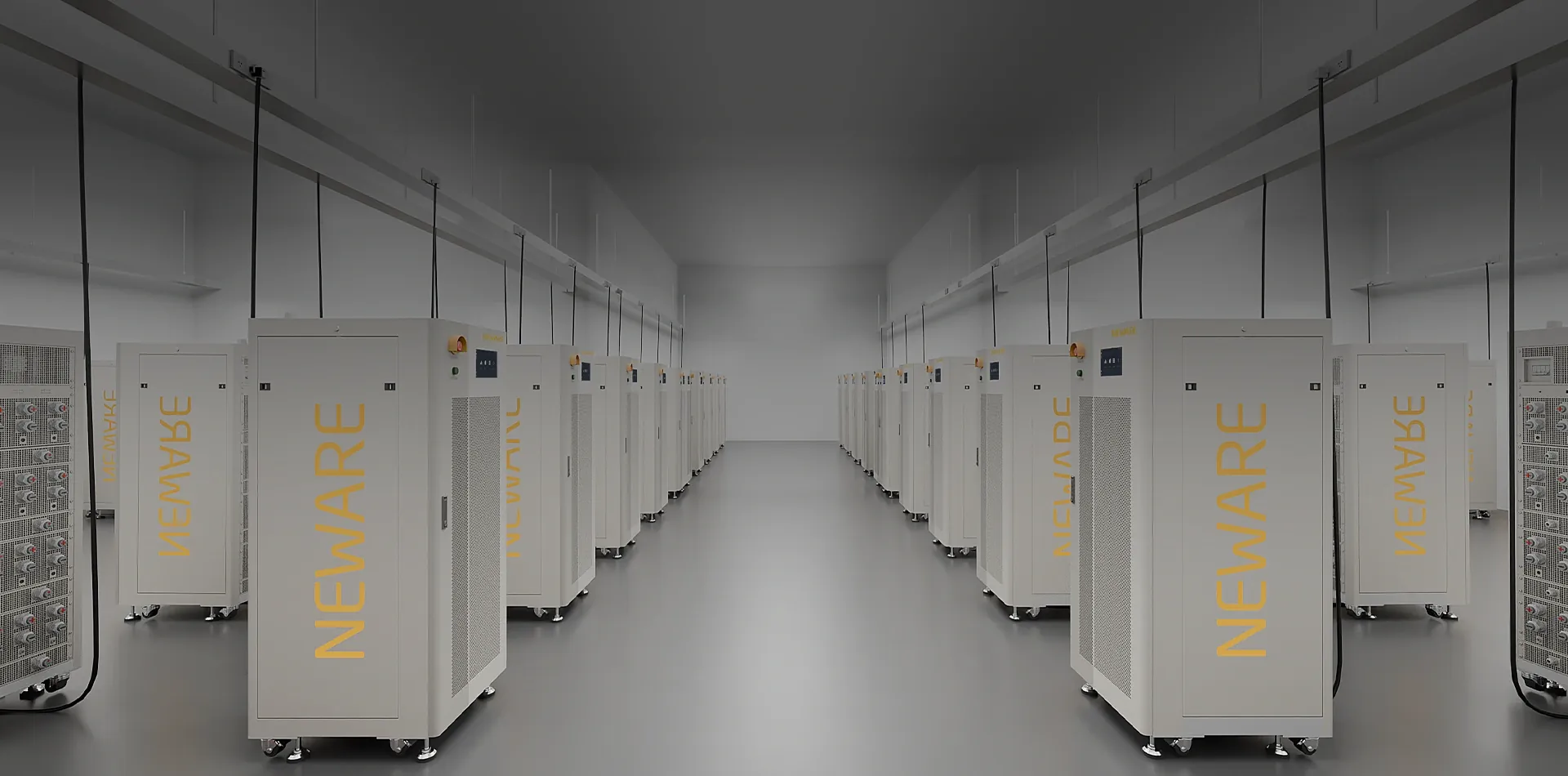
Selection guide
Give us the device, maximum voltage and maximum current. The recommendation stays inside the ranges published on this site — no invented models.
The selector is an interactive shortcut. Without JavaScript, use this table.
| Level | Series | Voltage | Current | Notes |
|---|---|---|---|---|
| Cell | CT-4008Q | ≤ 6 V | ≤ 300 A | Four auto ranges |
| Cell, precision | CT-9000 | ≤ 6 V | < 1 A and above | µA class, 1000 Hz |
| Large cell | CTE-8000 | ≤ 6 V | > 300 A | Energy recovery |
| Module | CE-6000 | 6–150 V | ≤ 1200 A | BMS communication |
| Pack | CE-7000 / BTS-6000-IGBT | 150–1500 V | ≤ 1200 A | Energy recovery |
Typical classes, model-dependent. Final ratings, channel count and options are confirmed at quotation.
Recommended series
Cell level, up to 300 A: the four-range CT-4008Q channel covers the envelope with one wiring setup.
Download the series datasheetRecommended series
Cell level and below 1 A: the CT-9000 µA-class channel adds the precision and 1000 Hz sampling this envelope needs.
Download the series datasheetRecommended series
Large-format cell above 300 A: the CTE-8000 regenerative channel is the published fit for this current.
Download the series datasheetRecommended series
Module level, 6–150 V: CE-6000 pairs regenerative power stages with BMS communication.
Download the series datasheetRecommended series
Pack level, 150–1500 V: CE-7000 / BTS-6000-IGBT cover full-pack cycling with energy recovery.
Download the series datasheetEnter maximum voltage and current to see a series.
That voltage or current is outside the published ranges (up to 1500 V; up to 2000 A at cell level or 1200 A at module and pack level). Contact an engineer and we will confirm a configuration instead of guessing.
By application
Three common starting points. Each card names the series we would shortlist and the published figures that decide the fit.
Module cycling and end-of-line routines where the pack stays under 150 V and the line needs pass/fail results.
Recommended series CE-6000
Full-pack cycling for ESS and EV packs, with BMS communication and discharge energy returned to the grid.
Recommended series CE-7000 / BTS-6000-IGBT
High-voltage pack testing at full current, where the 1500 V class and 1200 A are both needed.
Recommended series BTS-6000-IGBT


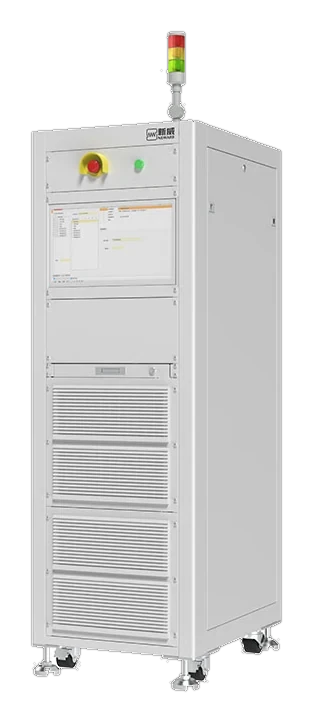

Test profiles
Representative profiles for the tests this platform is bought to run. Rates are C-rates; durations are typical and depend on cell capacity, cooling and limits.
| Test | Typical profile | Rate | Duration |
|---|---|---|---|
| Capacity | 0.5C CC-CV charge, 0.5C discharge | 0.5C | 6–10 h |
| Cycle life | 1C/1C continuous cycling at 25 °C | 1C | 1,000–5,000 cycles |
| DCIR | 10 s 1C pulse, 10 s rest | 1C | <2 min / point |
| HPPC | 10 s pulses, 10–90% SoC | 1–2C | 3–6 h |
Profiles are illustrative and must be validated for the specific cell and fixture. Final parameters are agreed at quotation.
Regenerative conversion, BMS integration and end-of-line routines in one system. Figures are typical and model-dependent.
Company-reported and typical. Voltage, current and feedback figures vary by model and are confirmed at quotation.
Instead of burning discharge energy as heat, the power stage converts it back to mains. The result is lower heat load and a lower energy bill per test hour.
Pick the voltage class that matches the device under test, then the current your profile needs. Final ratings are set at quotation.
| Model (class) | Max voltage | Max current | Energy feedback | BMS comms | Typical use |
|---|---|---|---|---|---|
| Module class (60 / 120 V) | 60 / 120 V | Specify at quotation | >90% | CAN / SMBus | Module and string cycling |
| Pack class (1500 V) | 1500 V | 1200 A | >90% | CAN / SMBus / CAN-FD | Full-pack cycling, drive-cycle profiles |
| Pack EOL class (1500 V) | 1500 V | 1200 A | >90% | CAN / SMBus / CAN-FD | End-of-line pass/fail routines |
Tiers are indicative. Ratings are typical, model-dependent. Part numbers are confirmed at quotation.
A complete line is more than a power cabinet. These are the elements we configure together; the exact mix is set at quotation.
| Element | Typical specification | Notes |
|---|---|---|
| Power cabinets | 1–6 cabinets per station | Parallel cabinets raise current; each cabinet keeps its own protection. |
| Voltage / current class | 100 V module class or 1500 V pack class | Current rating depends on the profile, not only the pack capacity. |
| BMS interface | CAN, SMBus, CAN-FD; DBC import | Pack communication specification is required before quotation. |
| Fixtures and cabling | Busbar, lug or custom harness | Supplied to the pack terminal geometry; high-voltage interlocks included. |
| Safety | Contactors, insulation monitoring, emergency stop | Integrated with the test controller; site-specific rules apply. |
| Software | BTS 9.1 with EOL routines | Schedules, limits, pass/fail records and LIMS-friendly export. |
Illustrative configuration. Channel and cabinet counts, fixtures and interfaces are confirmed at quotation.
Clear boundaries make a proposal easier to trust. If your test needs one of these, say so and we will scope it separately.
Pack-system datasheets are configuration-specific: voltage class, current, BMS interface and cabinet count change the specification. The shared measurement-platform datasheets are in the resources centre; request the pack sheet for your configuration.
Start from the highest voltage you will test. Module work usually stops well below 100 V; full packs need the 1500 V class. Current, cabling and BMS interface follow from the pack specification and are confirmed at quotation.
Regenerative discharge returns more than 90% of discharge energy to the grid instead of dissipating it as heat. Over a production line running continuous cycles, that changes both the energy bill and the cooling load. Typical, model-dependent.
CAN, SMBus, CAN-FD and DBC-described messages. Send the pack's communication specification with your enquiry so the interface and message set can be confirmed before quotation.
Yes. A 1500 V class system covers both, provided the current rating suits the profile. The voltage window and current are configured per project; do not size the system from pack nominal voltage alone.
EOL routines run on the same BTS 9.1 controller as development cycling, with limits and pass/fail results recorded per pack. A separate EOL station is not required unless the line layout calls for one.
Pack voltage range, maximum charge and discharge current, the test profile, BMS protocol and connector details, station count and the site's power available. With those, we can return a configured proposal and an energy-feedback estimate.
Company-published typical values for the main series. The exact model and option set are confirmed at quotation.
| Series / model | Voltage | Current | Accuracy | Sampling / response | Typical use |
|---|---|---|---|---|---|
| 20 / 30 V | 10–15 A | V ±0.02% FS | Confirm at quotation | Small modules and packs | |
| 60 / 120 V | 50 / 100 / 200 A, 8–12 ch | V ±(0.02% FS + 0.02% RD) · I ±(0.05% FS + 0.05% RD) | Confirm at quotation | Module cycling | |
| 60–1000 V | 100–1000 A; 75–600 kVA | ±0.1% FS | Confirm at quotation | Pack cycling; >90% energy recovery | |
| 300–1500 V | 100–1200 A | Confirm at quotation | Confirm at quotation | High-voltage pack testing |
Values are typical and company-published. Accuracy is stated as % FS unless shown otherwise. Confirm the final model, range and option at quotation.
NEWARE Technology
Send the pack voltage, current profile, BMS protocol and station count. We return a configured proposal with energy-feedback estimates, lead time and service options. We reply typically within one business day.
Talk to an engineer
Request a quote