Applications
Battery test protocols for the chemistry in front of you
Six application areas, one test platform. Each section lists the capabilities that decide whether a test is valid — and the specs that support them.
All figures are typical, model-dependent. Final specification is confirmed at quotation.
Typical test profiles
What each application actually runs
Representative profiles, not universal recipes. A profile is adapted to the cell, the cooling design and the question the test has to answer.
| Application | Typical profile | Sampling | Temperature | Recommended system |
|---|---|---|---|---|
| Solid-state | 0.05C–0.2C formation; µA leakage holds | 100 Hz | 25 °C, then chamber sweep | CT-9000 µA class + chamber |
| Sodium-ion | 0.5C formation; 1C cycling across the Na-ion window | 100 Hz | 25 °C | 512-channel formation cabinet |
| Fast charge | 4C charge pulses; 6C boost segments | 1000 Hz | 25–45 °C | 5 V / 300 A cell class |
| Energy storage | 0.5C charge/discharge; multi-thousand-cycle life test | 1–10 Hz | 25 °C, chamber optional | 1500 V / 1200 A pack class |
| Electric vehicles | Drive-cycle profile plus end-of-line check | 100–1000 Hz | 25 °C or chamber | 1500 V pack / EOL class |
| Supercapacitors | High-current charge/discharge pulses; lifetime cycling | 1000 Hz | 25 °C | 5 V / 300 A cell class |
Profiles are illustrative and must be validated for the specific cell. Rates are C-rates relative to rated capacity; sampling and temperature are typical, model-dependent.
01 · Solid-state
Solid-state cells
Solid-state cells pair thin electrolytes with high-voltage cathodes, and the first cycles decide how that interface forms. Small currents carry the signal: leakage in the microamp range can dominate a result. The tester must hold accuracy at low current and change ranges without disturbing the cell.
Coin and small pouch formats are common at this stage, so channel density matters as much as precision.
Typical profile: 0.05C–0.2C formation with µA leakage holds at 25 °C. Recommended: CT-9000 µA class with a chamber for the temperature sweep.
Recommended configuration: CT-9000 µA class · 128 channels · coin and pouch clamps
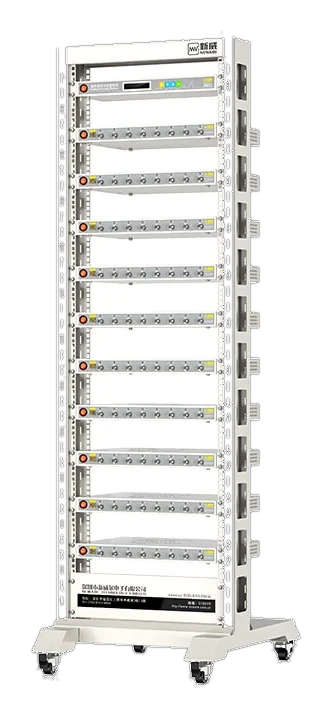
What matters
- 4 auto-ranges, 100 µA–300 A
- Voltage accuracy ±0.01% FS
- Current accuracy ±0.02% FS
- Sampling to 1000 Hz
- Chambers −70 to +150 °C
Typical, model-dependent. Specify at quotation.
02 · Sodium-ion
Sodium-ion cells
Na-ion cells use a different voltage window and are often cycled on pilot lines before the chemistry is fixed. Formation and grading must hold consistent accuracy across hundreds of channels, because cell-to-cell spread is the measurement. Protocols change often, so engineers need to edit steps without reprogramming the cabinet.
Typical profile: 0.5C formation, then 1C cycling across the Na-ion window. Recommended: a 512-channel formation cabinet with BTS 9.1 recipe editing.
Recommended configuration: Formation cabinet · 512 channels · prismatic trays
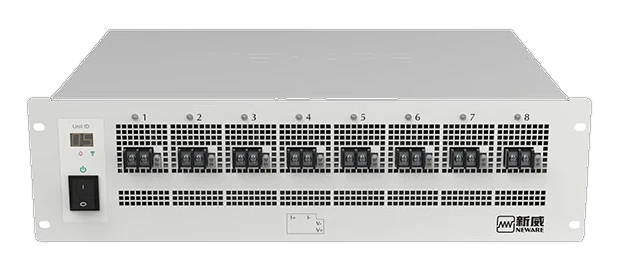
What matters
- 512 channels per cabinet
- ±(0.2% RD + 0.2% Range)
- Negative-pressure formation
- BTS 9.1 protocol editing
- Chambers −70 to +150 °C
Typical, model-dependent. Specify at quotation.
Fast-charge protocols
Fast charge pushes current in short pulses, and the cell responds within milliseconds. A tester that samples too slowly misses the voltage overshoot that decides whether a step is safe. The current loop must settle before the next step begins, or the profile you programmed is not the profile the cell sees.
Typical profile: 4C charge pulses with 6C boost segments, logged at 1000 Hz between 25 and 45 °C. Recommended: a 5 V / 300 A cell class.
Recommended configuration: CT-4008Q 5 V / 300 A · 96 channels · four-wire clamps

What matters
- 1000 Hz sampling
- 10 / 100 / 1000 Hz selectable
- Current response ≤100 µs (9-series)
- Current accuracy ±0.02% FS
- 300 A range per channel
Typical, model-dependent. Specify at quotation.
Energy storage systems
Grid-scale projects are judged on round-trip efficiency and cycle life over years, so pack tests run continuously. Regenerative discharge returns energy to the facility instead of losing it as heat. BMS data must land in the same record as electrical data, or capacity fade cannot be traced back to cell behaviour.
Typical profile: 0.5C charge/discharge, multi-thousand-cycle life test, BMS logging. Recommended: a 1500 V pack system with regenerative stages.
Recommended configuration: CE-6000 1500 V / 1200 A · 24 channels · BMS harness
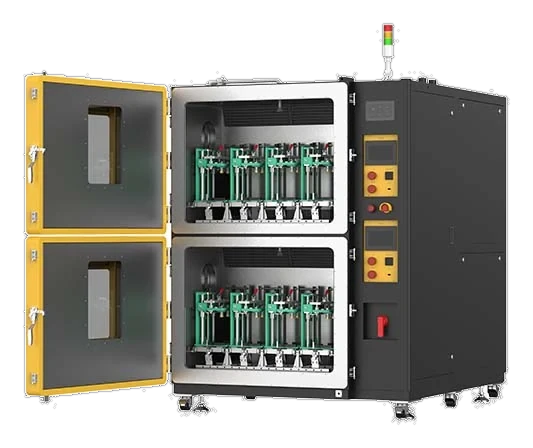
What matters
- Pack systems to 1500 V / 1200 A
- Energy feedback >90%
- Power factor 0.99
- CAN / CAN-FD / DBC logging
- Chambers −70 to +150 °C
Typical, model-dependent. Specify at quotation.
EV modules and packs
Vehicle packs combine high voltage with short end-of-line takt times. A test stand must run drive-cycle profiles, check BMS messages and log each pack against its serial number. The same system should cover engineering validation and production EOL, so teams do not maintain two software stacks.
Typical profile: a drive-cycle profile plus an end-of-line pass/fail check, logged at 100–1000 Hz. Recommended: a 1500 V pack class with EOL routines.
Recommended configuration: CE-6000 1500 V · 12 channels · EV pack dock
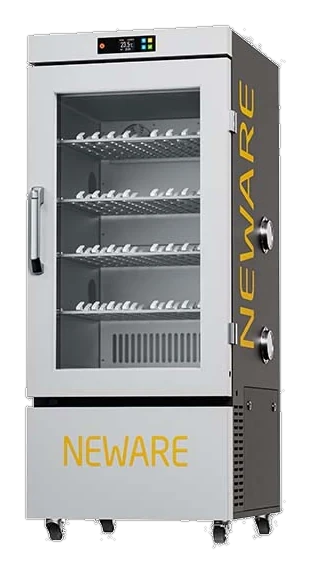
What matters
- 1500 V / 1200 A pack class
- Current response ≤100 µs (9-series)
- CAN / CAN-FD / DBC support
- BTS 9.1 and LIMS traceability
- Chambers −70 to +150 °C
Typical, model-dependent. Specify at quotation.
Supercapacitors and EDLCs
Supercapacitors accept and deliver current in bursts, so tests are dominated by high-current pulses and long lifetime runs. Capacitance and internal resistance come from the transient, not the steady state. A wide current range and a fast, stable loop determine whether those values are repeatable.
Typical profile: high-current charge/discharge pulses and lifetime cycling at 1000 Hz. Recommended: a 5 V / 300 A cell class with long-run logging.
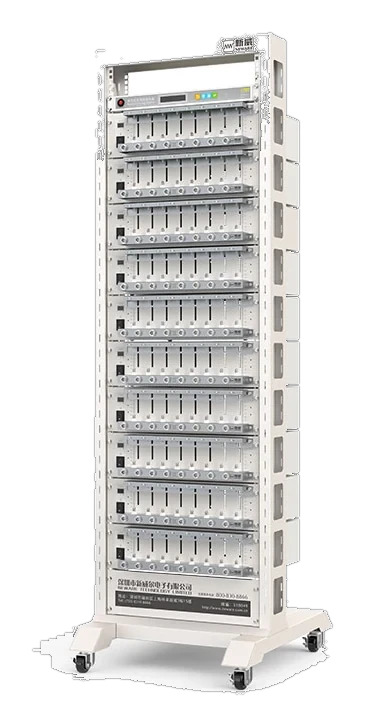
Recommended configuration: CT-4008Q 5 V / 100 A · 96 channels · low-ESR clamps
What matters
- 4 auto-ranges, 100 µA–300 A
- Current response ≤100 µs (9-series)
- 1000 Hz sampling
- Current accuracy ±0.02% FS
- Long-run cycling with data logging
Typical, model-dependent. Specify at quotation.
Application questions
Can one tester cover solid-state and fast-charge work?
Often, yes. A four-range channel covers µA leakage and high-rate pulses, but the current class has to match the largest pulse and the channel count has to match the batch. If the two programmes run concurrently, a mixed rack is usually more practical than one universal channel.
What sampling rate do I need for 4C fast charge?
1000 Hz is the usual choice when you need to see voltage overshoot and current settling inside a pulse. At 10 Hz you capture the trend but not the transient. The rate is selectable per test, so slow cycle-life runs can use a lower rate and smaller files.
Do energy-storage tests need a chamber?
Not always. Many pack life tests run at ambient temperature with temperature monitored at the pack. If the specification includes seasonal or thermal-cycling conditions, a chamber or an all-in-one configuration is required.
How do you handle BMS data in an EV pack test?
CAN, SMBus and CAN-FD links bring BMS messages into BTS 9.1, with DBC files mapping signals to named channels. Cell voltages, temperatures and state-of-charge then sit on the same time base as pack current and voltage.
Are these profiles standard test methods?
No. They are representative engineering profiles, not published standards. Formal methods such as IEC or UN transport tests have their own procedures and acceptance criteria; we configure the system to run them, but the method and the pass criteria remain yours.
Match a system to your protocol
Send the voltage window, current profile and channel count. We reply with a configuration, the relevant accuracy figures and a lead time — typically within one business day.
