Recommended series
CT-4008Q
Cell level, up to 300 A: the four-range CT-4008Q channel covers the envelope with one wiring setup.
Download the series datasheetTypical values, model-dependent. Final specifications are confirmed at quotation.
Cell testers · µA to 300 A
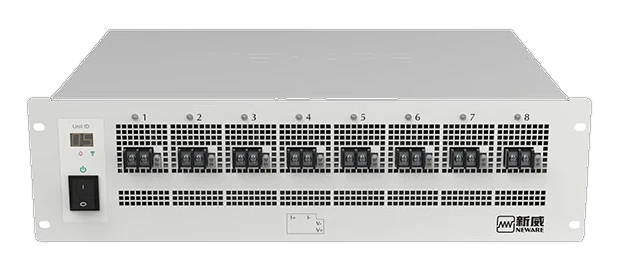
A single cell-testing channel that switches across four current ranges automatically, so quiescent-current checks and high-rate pulses run on the same wiring.
Built for coin, pouch and prismatic cells. Voltage accuracy is ±0.01% FS and current accuracy ±0.02% FS — typical, model-dependent. Sampling is selectable at 10, 100 or 1000 Hz, and current response is ≤100 µs on 9-series channels.
Selection guide
Give us the device, maximum voltage and maximum current. The recommendation stays inside the ranges published on this site — no invented models.
The selector is an interactive shortcut. Without JavaScript, use this table.
| Level | Series | Voltage | Current | Notes |
|---|---|---|---|---|
| Cell | CT-4008Q | ≤ 6 V | ≤ 300 A | Four auto ranges |
| Cell, precision | CT-9000 | ≤ 6 V | < 1 A and above | µA class, 1000 Hz |
| Large cell | CTE-8000 | ≤ 6 V | > 300 A | Energy recovery |
| Module | CE-6000 | 6–150 V | ≤ 1200 A | BMS communication |
| Pack | CE-7000 / BTS-6000-IGBT | 150–1500 V | ≤ 1200 A | Energy recovery |
Typical classes, model-dependent. Final ratings, channel count and options are confirmed at quotation.
Recommended series
Cell level, up to 300 A: the four-range CT-4008Q channel covers the envelope with one wiring setup.
Download the series datasheetRecommended series
Cell level and below 1 A: the CT-9000 µA-class channel adds the precision and 1000 Hz sampling this envelope needs.
Download the series datasheetRecommended series
Large-format cell above 300 A: the CTE-8000 regenerative channel is the published fit for this current.
Download the series datasheetRecommended series
Module level, 6–150 V: CE-6000 pairs regenerative power stages with BMS communication.
Download the series datasheetRecommended series
Pack level, 150–1500 V: CE-7000 / BTS-6000-IGBT cover full-pack cycling with energy recovery.
Download the series datasheetEnter maximum voltage and current to see a series.
That voltage or current is outside the published ranges (up to 1500 V; up to 2000 A at cell level or 1200 A at module and pack level). Contact an engineer and we will confirm a configuration instead of guessing.
By application
Three common starting points. Each card names the series we would shortlist and the published figures that decide the fit.
Leakage, standby and micro-cycling on coin and small pouch cells, where microampere resolution matters more than throughput.
Recommended series CT-9000
Formation, cycling and rate tests on pouch and prismatic cells in the milliamp to 30 A class.
Recommended series CT-4008Q
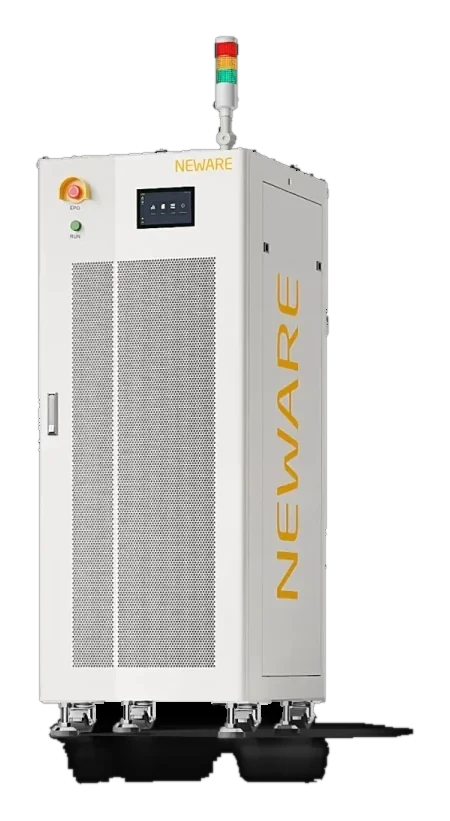
High-rate pulses and fast-charge work on large-format cells, with a regenerative channel that keeps heat and energy cost down.
Recommended series CTE-8000


Test profiles
Representative profiles for the tests this platform is bought to run. Rates are C-rates; durations are typical and depend on cell capacity, cooling and limits.
| Test | Typical profile | Rate | Duration |
|---|---|---|---|
| Capacity | 0.2C CC-CV charge, 0.2C CC discharge | 0.2C | 5–8 h |
| Cycle life | 1C/1C continuous cycling at 25 °C | 1C | 500–3,000 cycles |
| DCIR | 10 s 1C pulse, 10 s rest, 10 points | 1C | <1 min / point |
| HPPC | 10 s discharge and charge pulses, 10–90% SoC | 1–3C | 2–4 h / profile |
Profiles are illustrative and must be validated for the specific cell and fixture. Final parameters are agreed at quotation.
Four auto ranges cover the full span from microampere leakage to 300 A pulse testing. No re-cabling between tests.
Typical, model-dependent. Channel counts and range mix are configured at quotation.
The channel picks the narrowest range that covers the present current, then moves up or down as the profile changes.
Choose the current class per channel, then set the channel count per rack. Every class keeps four auto ranges and selectable sampling.
| Model (class) | Voltage | Current | Auto-ranges | Sampling | Typical use |
|---|---|---|---|---|---|
| 5 V / 100 µA class | 5 V | 100 µA | 4 / ch | 10 / 100 / 1000 Hz | Leakage, standby drain, micro-cycling |
| 5 V / 1 mA class | 5 V | 1 mA | 4 / ch | 10 / 100 / 1000 Hz | Coin cells, low-rate cycling |
| 5 V / 6 A class | 5 V | 6 A | 4 / ch | 10 / 100 / 1000 Hz | Pouch and prismatic cycling |
| 5 V / 300 A class | 5 V | 300 A | 4 / ch | 10 / 100 / 1000 Hz | High-rate pulses, fast-charge profiles |
Tiers are indicative. Exact voltage, current and channel counts are configured at quotation. Part numbers are confirmed at quotation.
A rack is quoted as a working system, not as a list of modules. These are the elements that get configured together.
| Element | Typical specification | Notes |
|---|---|---|
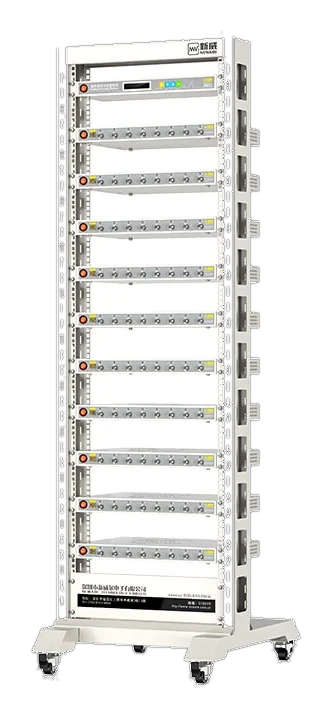
| Channels per rack | 8–80 channels, class-dependent | Channel count follows the cell batch and available floor space. |
| Current classes | µA, mA, 6 A, 20 A, 30 A or 300 A | Classes can be mixed within a rack at quotation. |
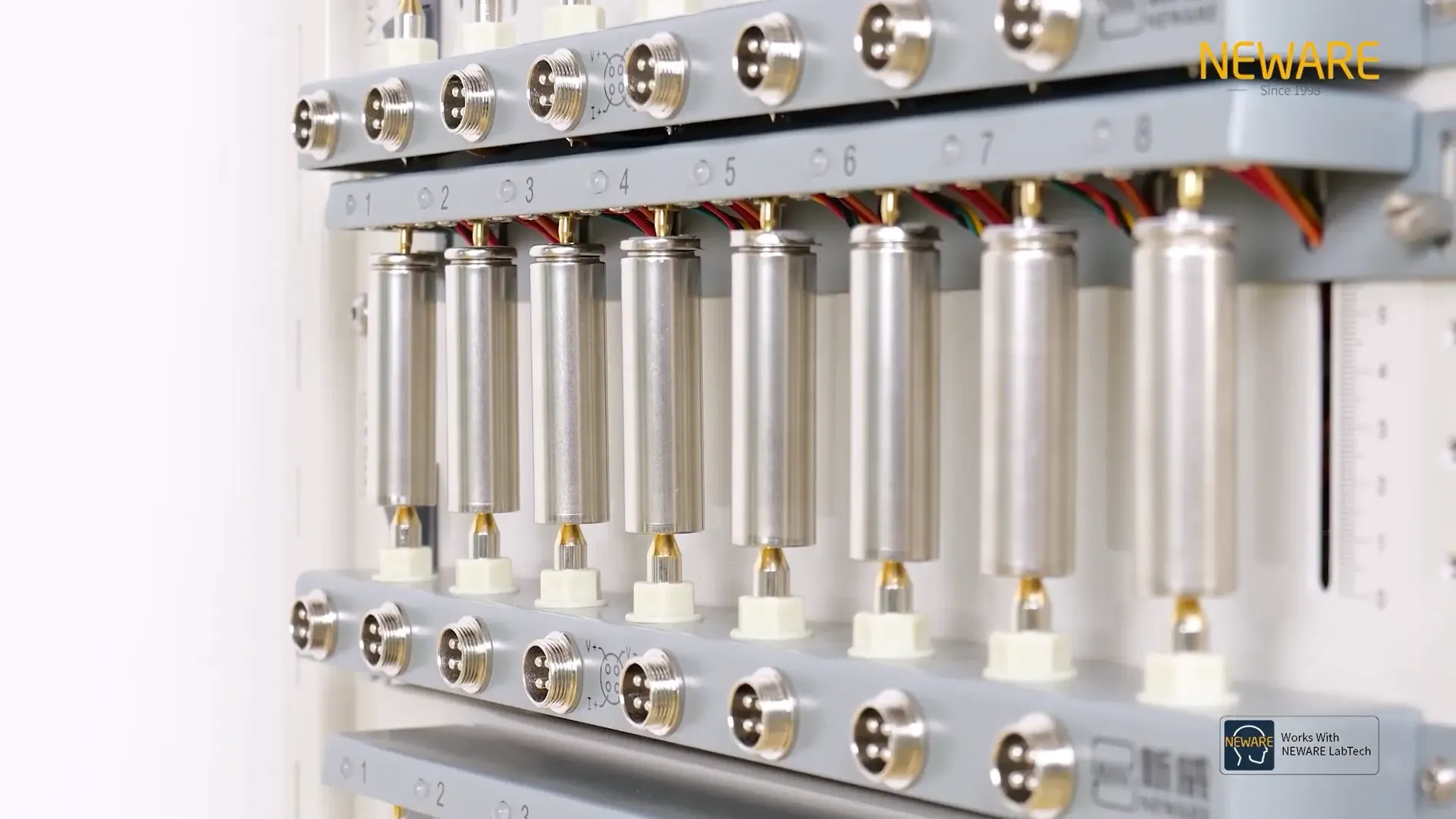
| Rack | 19-inch cabinet, 660 × 760 × 1950 mm typical | Module height and shelf spacing depend on the channel mix. |
| Fixtures | Pouch clamps, cylindrical holders, prismatic trays | Selected by cell format and terminal geometry. |
| Cabling | 0.5 m bench leads or 3.0 m chamber leads | Longer leads are available for chamber installations. |
| Software | BTS 9.1 | Schedules, limits, audit trail and LIMS-friendly export. |
| Calibration | CNAS calibration available | Certificate and uncertainty statement issued per calibration. |
Illustrative configuration. Channel mix, fixtures and cabling are confirmed at quotation.
Cell testers are precise, but they are not universal instruments. These boundaries matter when you compare quotes.
Official datasheets for the cell-testing range and the BT-9562 impedance tester. File sizes are shown for slow links.
Start from the largest pulse in your protocol, not the nominal capacity. A 5 V / 300 A class channel covers high-rate pulses and fast-charge work; a 5 V / 6 A class channel is the usual fit for pouch and prismatic cycling; µA-class channels suit leakage and standby measurement. Typical, model-dependent.
Choose 1000 Hz when you need to resolve fast-charge transients or short pulses. For slow formation and long-duration cycling, 10 Hz or 100 Hz logging is usually enough. All three rates are selectable per test.
Count the cells you run concurrently, then add headroom for repeats and failed runs. Channel counts per rack are specified at quotation, so the rack can be sized to the station rather than to a fixed shelf.
Racks are configured per project. Share the current mix — µA-class, mA-class, 6 A-class and 300 A-class — and we will propose channel groups. The exact configuration and part numbers are confirmed at quotation.
A cell tester applies charge and discharge current and logs voltage, current and capacity over time. The BT-9562 impedance tester applies a 1 kHz AC signal and measures internal resistance, reactance and impedance phase. They answer different questions and are usually used together.
Yes, with 3.0 m leads and a chamber cable port. The channel electronics stay outside the chamber unless you select an All-in-One chamber, where the cycler is integrated inside the enclosure.
Company-published typical values for the main series. The exact model and option set are confirmed at quotation.
| Series / model | Voltage | Current | Accuracy | Sampling / response | Typical use |
|---|---|---|---|---|---|
| 5 V | 0.1 / 1 / 10 / 100 mA, 4 ranges | V ±0.01% FS · I ±0.02% FS | 10 Hz, ≤1 ms; min. pulse 500 ms | Coin cells, leakage and micro-cycling | |
| 5 V | 100 mA–6 A / 12 A, 4 ranges | V/I ±0.02% FS | 10 Hz, ≤1 ms | Pouch and prismatic cells | |
| 5 V | 1 / 6 / 12 / 20–30 A, 4 ranges | ±0.05% FS | 10 Hz, ≤1 ms | High-rate cycling and pulses | |
| 0–5 V | 0.1 µA–5 A, 4 ranges (195 µA range) | ±0.02% FS | 1000 Hz, ≤100 µs | GSM pulse, DCIR, HPPC |
Values are typical and company-published. Accuracy is stated as % FS unless shown otherwise. Confirm the final model, range and option at quotation.
NEWARE Technology
The parts that turn a channel into a repeatable measurement. Specifications are the published typical values.
| Accessory | Specification | Use |
|---|---|---|
| BVIR internal-resistance meter (CR-20V-2000Ω) | 0–20 V; 200 mΩ / 2000 mΩ auto range; 1 kHz, 100 readings/s; four-terminal | Cell and module DCIR |
| AUX voltage / temperature channels | −5 to +5 V ±0.1% FS; NTC −25 to 110 °C; thermocouple −200 to 260 °C, ±1 °C | Reference and ambient monitoring |
| SMT / sense harness | Configured to channel count and fixture layout | Voltage sense and temperature integration |
| Cell fixtures | Pouch clamps and prismatic trays made to the cell format | Repeatable contact and alignment |
| Chamber racks / feedthroughs | Configured to chamber volume and channel count | Lead routing into temperature tests |
Accessory availability and exact specification depend on the tester model and chamber. Confirm with the configuration.
What the instrument sees — the cell formats it drives, the waveforms it resolves and the ranges that hold accuracy across both.
Send your voltage window, current classes and channel count. We return a configured proposal with lead time, calibration options and a data-management outline — typically within one business day.
Talk to an engineer
Request a quote